Psych37@222
Sensory Memory, STM, LTM
11/29/00
Memory
and Learning: Memory Introduction
1) Memory and learning inextricably
interwoven processes: can't have one system without the other
Learning
without memory without learning;
Without
memory: Conditioned Stimuli
Consequences
Model activity
No language
No consciousness no humanness
HM
retrograde amnesiac/age 27/hippocampal lesion
2) History: In search of an
Engram
Karl Lashley and
the Engram: neural circuitry of leaning and
memory trace and
localization
No
memory at all
Vast
improvements: encephalitis, Korsakoff's syndrome, and HM
Memory
involve storing information over time (1 second to a lifetime)
S-R
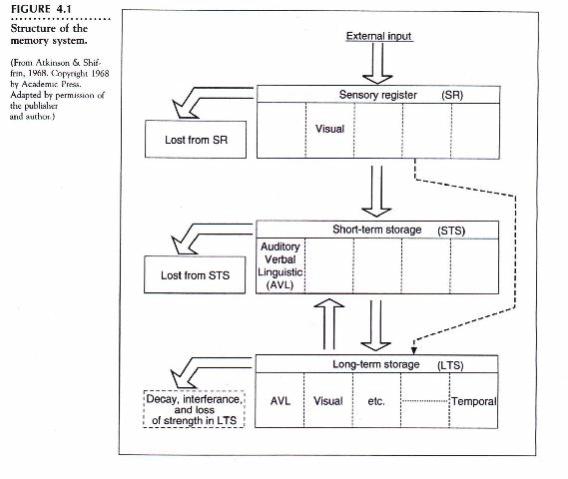
vs Cognitive. Information processing cognitive has won the day Atkinson and
Shiffrin (1968)
Page 2
3)
Elaboration's on Atkinson and Shiffrin (1968)
Stage
model and information processing:
Processing
stages:
surmount
3 obstacles=accuracy
1)
encoding or acquisition: perceive item and record
2)
storage hold information for later storage
3)
retrieval locate and use
------------------------------------------------------------------------
overhead
-------------------------------------------------------------------------
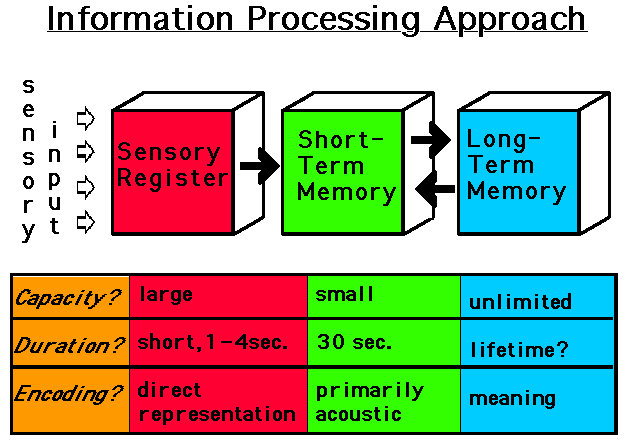
Sensory
input ---
sensory memory----STM-------LTM
Page 3
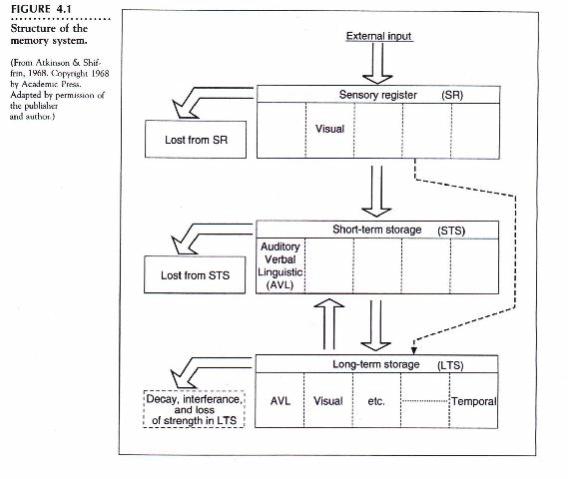
The Atkinson-Shiffrin
Model
The Atkinson-Shiffrin Model

This is a structural model which suggests that people have their memory stored in sensory store, short-term and long-term memory. Sensory memory results from some form of stimulation and can be classified as either iconic memory or echoic memory. Short-term memory is temporary and it is similar to attention. Long term memory is permanent and it is generated from understanding of meaningful or emotional 'material'. It is more complicated and can be classified as explicit versus implicit; conscious versus unconscious; declarative versus or non declarative.
.......................Page
4
Page
5
Page 6

- This approach illustrates the different impact on memory by different level of processing through verbal, acoustic or semantic of the information.
 |
 |
 |

- This model classified memory into episodic, semantic and procedural depending on the nature and content of information stored.
|
|
|
- This model perceived memory exhibiting multiple links to the network of cognitive process, biological process, animal behaviour, mathematical and so on.
|
|
|

 Neurobiology of Learning and Memory by Dr James L. McGaugh (University of
California, Berkeley)
Neurobiology of Learning and Memory by Dr James L. McGaugh (University of
California, Berkeley)
Functional Neuroimaging of Memory by Roberto Carbeaz (University of Alberta)
Journal of Experimental Psychology: Learning, Memory and Cognition
Cognitive Neuroscience Memory Laboratory
 Use an electronic test
  to test your current memory capacity.
Some fun game  about memory.
|
|
|