113@222
Equipotentiality states that the stimulus chosen as the CS is not important.
Long-delayed flavor
aversions.
Unique characteristics:
1) long ISI delay
2) virtually inextinguishable
obtained in 1 trial
Design:
Novel flavor consumed by
multi-dieted species (rat, human etc/ not Koala) if followed hours (4-6) by an
injection of a toxin (lithium) will cause a classically conditioned taste
aversion.
Page 2
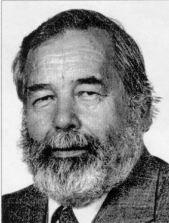
Role of John Garcia
CS > Flavor (vinegar)
UCS (toxin)
CR aversion in 1 trial and
with a long ISI.
Ramifications: Forces one to
review Pavlov and ISI rules governing classical conditioning. Forces us to
think about the genetic/biological nature of the learner.
Some conditioning,
apparently is extremely supraprepared like flavor aversions (1 trial, long ISI)
–
some prepared (like light
>shock) and some contraprepared (like noise >sickness). Preparedness
1) Prepared associations an innate propensity to form some
CS-US associations quickly because of
the animal's biological makeup.
2) Contraprepared associations refers to the difficulty in forming some CS-US associations because of the animal's biology.
3) Unprepared associations are CS-US associations formed after a
moderate number of trials; the animal
does not have any particular biological for these
predispositions.
Page 3
BRIGHT NOISY EXPERIMENT
Garcia and Koelling, 1966)
Applications.
Classic studies in
Conditioning and
Learning
Garcia Taste Aversion Study 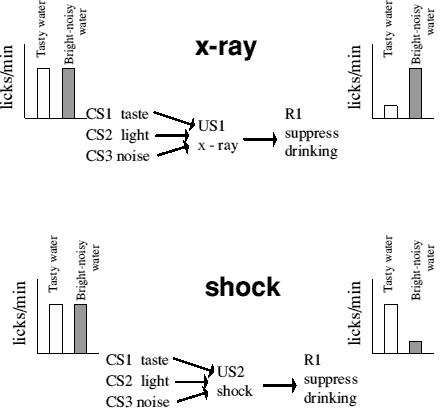
Bright Noisy Water
Experiment
Taste Aversion Learning Study
Phase 1 -- Rats are divided into the following three groups:
Group 1 -- Emitic drug will be given after Phase 2, rats get sick
½ hr. later.
Group 2 -- X-rays will be given after Phase 2, rats get sick ½
hr. later.
Page 4
Group 3 -- Each lick during Phase 2 is followed by a painful
electric shock..
Phase 2 -- All rats have ten minutes access to water. The water
has a slightly salty taste. Each
lick produces a click and flash of light.
Phase 3 -- The next day (rats in groups 1 and 2 have recovered),
the rats are again offered
water. The rats in each of the three main treatment groups are
further subdivided into three
groups, each offered water accompanied by only one of the three
potential CSs -- salty taste,
light flash, or tone. The results for the nine subgroups 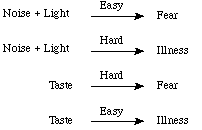 are:
are:
Conclusion: Animals are
biologically prepared to make some associations easier than others.Applications