IMPOSSIBLE
TASK STUDY 1
Running head: NEUROTICISM AND CONSCIENTIOUSNESS
Improvement but trouble with F
explanations and fig goes at the end, I am leaving for a bit but will get back
to your paper for more tangible feedback. mjl
Neuroticism and Conscientiuosness During an Impossible Task Performance
Kellyrose Wright
St. Bonaventure University
Impossible
Task Study 2
Abstract
The purpose of this study is to investigate the relationship between Neuroticism and
Conscientiousness on an impossible task. Past studies have discovered a
negative relationship between Neuroticism and Conscientiousness, as well as a
positive relationship between Conscientiousness and motivation. This study will
test the hypothesis that there is a negative relationship between Neuroticism
and motivation. Motivation will be assessed by the time participants spend
attempting to solve an impossible task. This score will be compared to the
participants’ scores on both the Conscientiousness and Neuroticism dimensions
of the NEO-PI. In my study I was looking for a main effect of
Conscientiousness, a main effect of Neuroticism, and an interaction between the
two variables. The results supported all three hypotheses.
Impossible Task Study 3
Neuroticism versus Conscientiousness as Related
to
Performance on an Impossible Task
Neuroticism is one of
the Big Five personality traits. The Big Five are five factors of trait
personality which appear the most often, and which encompass other related,
smaller traits. The dimension of Neuroticism “Measures
individuals according to their emotional stability and personal adjustment”
(Costa & McCrae; in Burger, 184). Individuals with high Neuroticism
scores tend to have wildly varying mood swings and frequently experience
emotional distress. Individuals with low Neuroticism scores are usually well
adjusted and calm, and do not demonst
IMPOSSIBLE TASK STUDY 4
Conscientiousness and
Motivation Conscientiousness has been shown to be closely
related to motivation, which is an important variable in determining
performance on many types of tasks. Motivation has
been defined as the choice of a) expending effort, b) the level of effort
expended, and c) persisting at that level of effort (Chamorro-Premuzic & Furnham, 2003).
Therefore, conscientiousness and general performance are related through the
factor of motivation. Neuroticism
and Conscientiousness are inversely related to each other In regards to Self-Handicapping as measured
by the Self-Handicapping Scale, it was found to be positively related to
Neuroticism and negatively related to Conscientiousness. There is a negative
relationship between Neuroticism and Conscientiousness, which is mediated by
the construct of self-handicapping (Ross et al,2002).
Self-Handicapping is defined as “A tendency for an individual to create
obstacles to successful achievement in performance or competitive situations in
order to protect or enhance one’s self-esteem” (Ross et al,2002).
It had already been discovered that there was a positive correlation between
Self-Handicapping and negative affect, which is very similar to Neuroticism.
This study investigated the relationship between Self-Handicapping and two of
the domain scales of the Five Factor Model of Personality, Neuroticism and
Conscientiousness. Ross stated that many investigators had previously reported
a negative relationship between these two domains. It was hypothesized that
Self-Handicapping would cause this negative relationship to be mediated. In
order for a mediational effect to be demonst
IMPOSSIBLE
TASK STUDY 5
significant correlation, and the mediator must be related
to these variables as well as reducing the significance of their relationship
when it is controlled. These were all fulfilled in Ross’ study, as
Self-Handicapping not only reduced the correlation between Neuroticism and
Conscientiousness, but changed the correlation to a positive one. Because the
hypothesis was validated, it is true that Neuroticism and Conscientiousness are
significantly negatively correlated, because that is one of the necessary parts
of proving mediation. Costa and McCrae, the creators of
the NEO-PI, have performed many tests comparing the five factors to each other,
and have reported the relationships between these factors. In Table 5 of their
assessment, “Internal Consistency and Factor Structure of NEO-PI-R Scales, the
data demonst
IMPOSSIBLE
TASK STUDY 6
associated with academic performance is Conscientiousness. High Conscientiousness
scores predict better academic performance (Chamorro-Premuzic
& Furnham, 2003). This study was one of the first
to consider that personality, not just intelligence, is a good predictor of
academic success. In fact, it was claimed that “Personality factors on their
own are powerful enough to explain a mode
IMPOSSIBLE
TASK STUDY 7
Conscientiousness. Therefore, I hypothesize that there will be a
main effect of Conscientiousness on time spent trying to solve an impossible
task.
Neuroticism is the personality factor which is most negatively correlated with
academic success. It has even been proposed that Conscientiousness may add to
academic performance beyond an individual’s intellectual ability (Chamorro-Premuzic & Furnham, 2003). In
this study by Chamorro-Premuzic et al, it was found
that the subtraits of Conscientiousness which were
most positively correlated with academic performance were dutifulness and
achievement striving. Additionally, the subtraits of
Neuroticism most negatively correlated with academic performance were anxiety
and impulsiveness. Hypothesis
2: In
groups of both successful and unsuccessful boys, the need for achievement and
expressed motivation of a fantasy nature was associated with Neuroticism.
However, when real-life examples were used, the need for achievement dropped.
This drop was positively correlated with Neuroticism (Finlayson, 2002). The
idea behind this study was that measures of success in school are related to: 1)The need for achievement, and 2)Neuroticism, which was conceptualized as “Reflecting the general
level of arousal or drive which a subject has”. In the Finlayson study, two
groups of students were divides into two groups as being either ’successful’ or
’unsuccessful’ academically. These decisions were made based on the past academic
performance of the students. Expressed motivation was then measured in each
group by administering two questionnaire measurements of expressed motivation-
one of fantasy achievement and one representing reality achievement. It was
hypothesized that the unsuccessful group of students would
IMPOSSIBLE
TASK STUDY 8
express more motivation towards fantasy achievement and the successful group
would express more motivation towards reality achievement. The reason for this
hypothesis was that the unsuccessful students had higher Neuroticism scores
than the successful students, and that Neuroticism is related to a loss of
reality and an increased belief in fantasy (Finlayson, 2002). Therefore, I
predict that there will be a main effect of Neuroticism on Conscientiousness. Conscientiousness has been shown to be strongly
related to achievement and motivation (Chamorro-Premuzic
& Furnham, 2003). Neuroticism has been shown to
be negatively related to achievement. It has also been demonst
IMPOSSIBLE
TASK STUDY 9
Method
Participants This
study consisted of 40 male and female undergraduate students. The participants
must be at least 18 years of age, be able to read, and must not have
participated in the study Conscientiousness and Performance on an Impossible
Task (Vittore et al, 2003). Materials This
study required the use of the NEO-PI personality index, as well as a list of 10
unsolvable anagrams. The NEO Personality Index was proven to be reliable in a
study by Young and Schinka in which scores from the
Personality Assessment Inventory were compared to scores from the NEO-PI and
found to have significant consistency. The validity of the NEO-PI was demonst
IMPOSSIBLE TASK STUDY 10
Procedure Participants will first be administered the
NEO-PI personality test and asked to complete it fully. When they have
finished, they will be given a sheet with the unsolvable anagrams on it. They
will be told that they can leave whenever they choose, and need not finish or even do any of the anagrams. The
time when they begin attempting to solve the anagrams will be recorded, as well
as the time when they give up attempting to solve the anagrams and leave the
study. The subjects will then be given a debriefing statement telling them the
purpose of the study and explaining the variables and the hypothesis. Scoring The
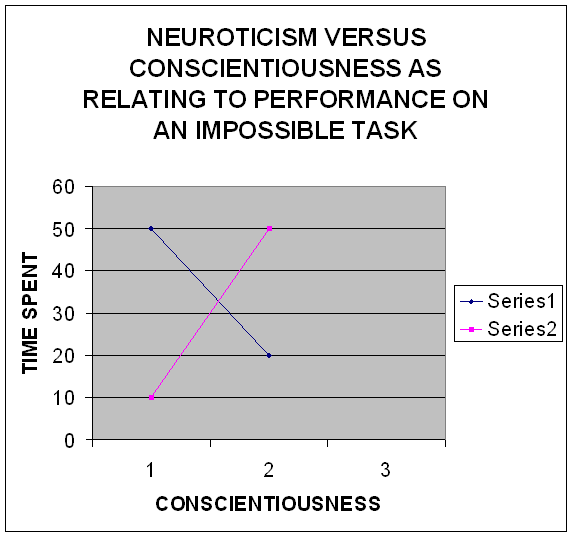
results were analyzed by using an Analysis of Variance. Results show that F(3,36)=126.982. The probability of obtaining this result is
less than .001. There was also an interaction present between Conscientiousness
and Neuroticism.
IMPOSSIBLE
TASK STUDY 11
IMPOSSIBLE TASK STUDY 12
References
Berger, C.R. (1973). Task performance and attribution
communication as determinants of interpersonal
attraction. Speech Monographs, 40(4), 280-286. Burger, J.M. (2000). Personality.
IMPOSSIBLE
TASK STUDY
13 Young, M.S. & Schinka, J.A. (2001). Research validity scales for the
NEO-PI-R: Additional evidence for
reliability and validity. Journal of Personality Assessment, 76(3), 412-420.