21@222 Page 1
Instrumental Learning I
1) law of effect and Thornkike/Watson(Little
Albert) : The Law of Effect (E. L. Thorndike)
“Of several responses made
to the same situation, those which are accompanied or closely followed by
satisfaction to the animalwill, other things being equal,
be more firmly connected with the situation, so that, when it
recurs, they will be more likely to recur;
those which are accompanied or closely followed by discomfort to the animal will, other things being equal, have their connections
with that situation
weakened, so that, when it recurs, they will be less likely to occur. The greater
the satisfaction or discomfort,
the greater the
strengthening or weakening of the bond." (Thorndike, 1898, p.244).
2) Enter Skinner
Operant Leaning
Learing involves sequencing
behavioral units
(R1-S1) via successive
approximations such that through shaping the learner will receive a
desirable consequence after the sequence is complete. Example (lab and non-lab)
Page 2
Lab example: Teach rat to
bar press: rats do not come into the world with the capacity to reflexively bar
press to receive a reward so therefore you have to train that animal via
successive approximation sequence training 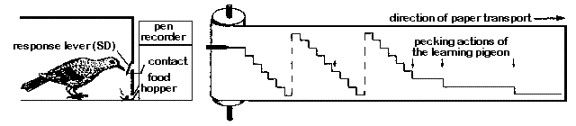 (shaping)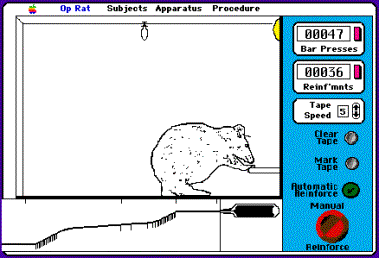
Page 2
Behavioral
units
R1-S1 placed in Skinner box
and runs
R2-S2 moves toward water
source and receives water (CS-UCS) Magazine training
R3-R3 Turns in the direction
of bar press (RFT)
R4-S4 Moves in the direction of bar press (RFT)
R5-S5 Touches right paw on bar press (RFT)
R6-S6 Places both paws on bar press (RFT)
Realize that all responses
that do not lead to a bar press-like response are
not reinforced
or extinguished.
R7-S7 Push bar down and get
(RFT)
Page 3
 .
.
Piano
Playing, free throws, studying, driving: Shaping, chaining, and successive
approximation
Monkey l eventually help disabled at home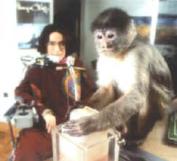
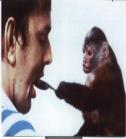
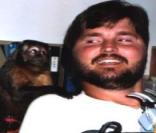
Helping
Hands has placed some 230 monkeys in foster care nationally and matched 45 with
people who have quadriplegia. The Koblinskis are one of five Michigan families
providing foster care for a capuchin.
Because these
monkeys live to the age of 35-40, they
can be long-term companions to quadriplegics.
For a monkey to successfully coexist with a quadriplegic, the animals
must be socialized from an early age
with
Page
4
humans.
When socialization is complete, the animals are sent to Helping Hands training
center in Boston,which is affiliated with Boston University School of Medicine
for nine months of training.
They
are taught to respond to a beam of light that the disabled ownerdirects from a
mouth-operated laser pointer. The owner shines the beam on an object he/she
wants the monkey to manipulate.
The monkeys learn to perform tasks such as fetching drinks from a refrigerator,
transferring items to and from the microwave. They are taught to place books on a reading stand and put
cassettes into a VCR. They can retrieve fallen mouthsticks or other tools.
1)
Contiguity R1 > S1 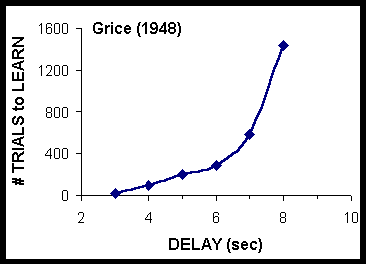
2)
Superstition: In six out of eight cases the resulting responses were so clearly
defined that two observers could agree perfectly in countinginstances. One bird
was conditioned to turn counterclockwise about the cage, making two or three
turns between reinforcements.Another repeatedly thrust is head into one of the
upper corners of the cage. A third developed a "tossing" response, as
if placingits head beneath an invisible bar and lifting it repeatedly."
(p. 168)
Page 5
3)
Contingency
4)
Extinction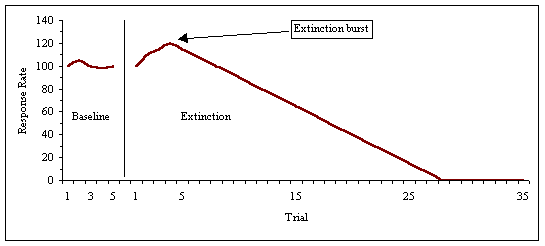
5)
Spontaneous Recovery
6)
Positive Reinforcer
A positive
reinforcer is an appetitive event whose presentation follows an operant
response. The positive
reinforcer
increases the likelihood of that behavior occurring again under the same
circumstances.