I.
Possible misuses of positive
reinforcement: Punished By Rewards:
Punished By Rewards:
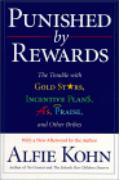
The Trouble with Gold
Stars, Incentive Plans,
A's, Praise, and Other
Bribes
A. Conditioned bribery
B. Conditioned greed
C. Undermining Intrinsic
Motivation
D. Aversiveness of being
controlled
E. Aversiveness of not being
in control
Page
2
Can you think of situations where objections to
the use of rewards might also be scrutinized and negatively evaluated. Misuses.
SUSPICION: Movement toward
cognition
Adverse
effects of tangible rewards:
1)
concrete reinforces as bribery (quid pro quo conditioning)
but
isn't how the real world operates, paychecks etc.merit raises, it does have
immoral connotations/ should you
reinforce for requirements of daily living: responsibility, moral
choice, kindness. wearing your retainer.)
2)
teaches greed: 20.00 bucks to clean room generalizes to I am
not going to engage in any behavior unless there is some tangible
reward
given. Use mild reinforces like social praise.Rat will stop bar pressing to
receive 2 pellets if you give it 6 pellets. Insist on getting more the next
time.
3)
be leery of administering non-contingent rewards; spoiled brat
4)
Be sensitive to the possibility of undermining intrinsic motivation;
Devalue
the activity;
Sometime
offering a reward for a task is a subtle statement suggesting the task is not
worth it, or certainly not worth doing for its own sake. Social praise wins out
over tangible rewards.
Leeper,
Greene, and Nisbett (1973) Drawing pictures and reinforcement.
Phase
1. assess spontaneous level of picture drawing base rate
Page
3
Provide
class with felt pens, paper, etc
Phase
2. A visitor is coming who would like to see the kind s of pictures you have
been drawing
R
group good drawer reward, trinkets, etc. and told to expect reward
UR
unexpected reward
NR
just keep drawing without reward
R
does not = base whereas UR and no reward = base
Results
and back to base rate and found that control = base line but experimental cut
to half time of base.
5) aversiveness of being
controlled
helplessness and
control
Glass
and Feldman told working on experiment dealing with stress on performance
proof
read manuscript and trace drawing while an aversive tone blared
Half
given button to push to terminate, and other .5.contingent group performed
better on drawing and proof. Stress reduced by control and hence better
performance. Control is good but the perception of control is critical. Ryan
and puzzle task:
group
1 good
group
2 you are doing as good as you should interest in task lower
Act
your age,
Tangible
reinforcement use: unattractive task
using principle of minimal force use least powerful reinforcement to be
effective.
Behavioral
contracts and control.
Parents
and kids sit around the table and discuss what they want form each other. What
do you want form me instead of this is what I want you to do
Best
alternative to reinforcement is modeling and imitation.
Alfie
Kohn, in his book Punished by Rewards, uses extensive
documentation to support his conclusion that
behaviorism is an
ineffective tool when
dealing with people, whether employees,
students, or children. He
argues that the using the carrot method of "do
this and you'll get that" leads to extrinsic
motivation, where the reward
is obtained by any means.
This leads to less intrinsic motivation and
Page
4
people ultimate lose
interest or care about the quality of work, or
amount of learning
achieved. He seems to want to over-turn the
mainstream theory that
the only way to achieve success is by one
person over-powering
another through their authority and bribes.
Current beliefs in
education include: teacher-centered classrooms,
behavior-management
programs, and learning achieved through bribes
and grades. Mr. Kohn
wishes to completely change this method of
thinking, and instead
create a "3C" classroom, with: collaboration,
content, and choice.
These classrooms eliminate rewards as the basis
for learning, and instead
create classrooms where kids want to learn
for the sake of knowledge
itself. The teachers and students work
together, often through
cooperative learning groups, to obtain
knowledge and understanding
relevant and interesting to the students n
their day-to-day lives.
I think that Mr. Kohn's
theory was well researched, explained, and is
believable. He clearly
explains the basic problem existing throughout
American society with the
use of rewards. As a future teacher,
thinking about ideas to
use in the classroom, I am eager to try his
methods with "kids
today." I would definitely recommend this book to
anyone dealing with kids,
who wants them to start caring about each
other, or the material
they are learning, rather than just doing the ork
to get the "A"
and then forgetting about it. I support his assessment of
education strategies
today, especially the honors students on the
"fast-track" to
college. Having just graduated with such a group, I
know all about the
all-night crams, cheating, copying, and generally
doing anything besides
learning the material to obtain the grade.
Although I agree with the
problem he addresses, I wonder if his
solution of a school
without grades is feasible. He does not require this
as part of his
"formula for success," merely suggests it. Additionally, I
would like to see the
argument and supporting evidence against his
theory. Obviously, he believes that the
mainstream theory does this
constantly in the real
world, so he need not show the opposite side.
However, I was left
wondering what studies and success stories the
behaviorists might pull
out to prove his theory wrong.
Overall, I believe that
each teacher needs to create an individual
learning environment in
his or her classroom. Creating a "perfect old"
for all successful
teachers will lead to cookie-cutter teaching. The
diversity of American
teaching should be as diverse as American
society. Teachers need to
sort through the various theories and beliefs,
and pick out those which
best suite their style and ability of teaching.
Page
5
No matter how
revolutionary and possibly effective Mr. Kohn's
theories might be, some
teachers may simply fail when trying to
implement them. This does
not make them bad teachers, only people
with different beliefs on
what education is and how to effectively relate
learning to students. I,
however, hope to find a way to implement Mr.
Kohn's ideas in my
classroom, because I think that some of them might
help me move my students
from empty minds to fill with knowledge
into excited and active
learners. --This text refers to the Paperback
edition.
Alfie
Kohn writes and speaks widely on human behavior, education,
and social theory. His
first book, No Contest: the Case Against
Competition, is regarded
as the definitive critique of competition. He is
also the author of The
Brighter Side of Human Nature: Altruism and
Empathy in Everyday Life
(1990) as well as dozens of articles in
academic journals and
popular magazines, including the New York
Times, the Atlantic
Monthly, the Journal of Education, the Nation, and
the Harvard Business
Review. A former teacher, he lectures and
conducts workshops for
educators, parents, managers, and researchers
across the country and
abroad. Kohn was educated at Brown
University and the
University of Chicago, and lives in Cambridge,
Massachusetts.