Impulsivity and Stress on Accuracy and Metacognition
Amanda
Buck
Functional Impulsitivy: The tendency to act with
relatively little forethought when such a style is optimal. These people work
quickly and are intelligent, therefore they are able to speed through certain
tasks without committing a great number of errors (Dickman,
1990). ). Previous research found
that some traits that are related to functional impulsivity are enthusiasm,
activity, and adventurousness (Dickman, 1990). This finding is consistent with the
fact that these people report that they actually benefit from their
impulsiveness (Dickman, 1990). These individuals are more productive; they
are also risk takers. It seems that even when these people make a high number
of errors it is offset by the amount of information that they contribute to the
task (Dickman, 1990).
Dysfunctional Impulsivity: “[…] a tendency to initiate
behavior before a situation has been analyzed adequately”(Caplan
& Shecter, 1990). These people are characterized by disorderliness and they
tent to ignore important information that is necessary to make accurate
decisions (Dickman, 1990). Another phrase that describes impulsiveness
is “not persistent” which is characteristic of dysfunctional impulsiveness.
These people do not report benefitting from their
impulsiveness (Dickman, 1990).
Stress: A situation that is
considered threatening or demanding and necessary resources are unavailable to
cope with the situation. For the purpose
of this study time pressure will be the stressor during a mathmatical
task which has also been known to provolk anxiety
(Cohen, Kamarck & Mermelstein, 1983).
Accuracy Scores: The number of questions
answered correctly on an arithmetic task.
Metacognition: “Knowing about what you know” ~ the predicted
accuracy, determined by individuals, and how confident individuals are about
the predicted percentage.
Article #1: Dysfunctional
and Functional Impulsivity have been shown to have differences in cost during
accuracy tasks. Functional impulsives
had higher scores and higher accuracy when answering questions. These subjects had a higher number of correct
answers within a limited time period (Dickman, 1990).
Article #2: Previous research has
suggested that personality plays a role in the accuracy of metacognition. Therefore, because impulsiveness is a
personality trait there should be a difference in the way functional impulsives and dysfunctional impulsives
respond to metacognition. (Pallier, Wilkinson,
Danthiir, Kleitman, Knezevic, Stankov, & Roberts, 2002). [In
general, people are ignorant about their own intellectual and social skills
(Hacker, Bol, Horgan & Rakow, 2000).
However, the more intelligent one is the better they are able to predict
metacognitive abilities accurately (Pallier, et al., 2002). Functional Impulsives
tend to be more confident (Dickman, 1990). Confidence
is a very important factor in determining accuracy of self-assessment therefore
it is plausible to conclude that individuals who are functionally impulsive
will be more accurate when making judgements about their performance. In
reference to metacognition, individuals generalize
their cognitive abilities, causing them to predict consistent levels of
confidence. Because of this pattern, confidence ratings are often inaccurate (Pallier, et al., 2002). Problem solving causes confidence
biases to occur because individuals tend to be over-confident about their
knowledge in such areas (Pallier, et al., 2002).]
Article #3: When subjects are faced
with time pressure, they are much less confident about the decisions they make
(Zautra, Reich, Davis, Potter, & Nicolson, 2000). Other studies have
been done on impulsivity and accuracy, which show that people who are high in
impulsivity are much more rapid in their speed of processing and less accurate
than others who were low in impulsivity.
It has been found by many that functional impulsives
are better with speed of processing information (Brunas-Wagstaff,
Bergquist and Wagstaff,
1994).
Article #4: Surprisingly, stress can
create positive mood states on certain occasions if the stressor is viewed as a
challenge and not a threat (Folkman & Moskowitz, 2000). Therefore, because
impulsiveness is a personality trait there will be an effect of stress on impulsiveness. Impulsive individuals have been found to react
to stress in a number of different ways. Dysfunctionally
impulsive people tend to react differently to environmental stressors than
functionally impulsive people. One study
shows that individuals who are low in impulsivity show a higher rate of
performance, according to speed and accuracy, than do individuals that are high
in impulsivity when put in stressful situations (Corr
& Kumari, 1998). These findings imply that
impulsive people are greatly affected by stress, and because dysfunctionally impulsive people tend to have a difficult time processing information, they will have more
of a deficit in accuracy when put under pressure. Surprising as it is, stress can create
positive mood states on certain occasions if the stressor is viewed as a
challenge and not a threat (Folkman & Moskowitz, 2000).
People who are functional impulsives may view
stress in a different way than people who are dysfunctional impulsives.
They have a different attitude about stressful tasks and different personality
characteristics that help them deal with the situation more productively. Because these individuals are enthusiastic
and highly productive, they tend to be more accurate when making decisions
under stressful situations.
My Study: 2 x 2 w/ 2 DVs
IV #1: Impulsivity w/ 2 levels:
Functional vs. Dysfunctional
IV #2: Stress w/ 2 levels: time
pressure vs. no time pressure
DV #1: Accuracy scores: number of
correct answers
DV #2: Metacognition: perceived
accuracy, and confidence rating
Main Effects:
As
stress levels increase functional impulsives will
have higher accuracy scores than dysfunctional impulsives.
Functional
impulsives will be more accurate and less confident
when predicting real scores than dysfunctional impulsives.
Interaction:
Accuracy
scores are dependent upon stress level and type of impulsivity.
Accuracy
and confidence in predicting scores
are dependent upon stress level and type of impulsivity .(as
stress increases individuals are even less confident about the predictions that
they make.)
My Hypothesis: Main effects for type of
impulsivity and stress, and an interaction between all variables.
#1: After considering this
information, it is hypothesized that when participants are completing a mathematical
task under stressful conditions, the functional impulsives
will have higher accuracy than the dysfunctional impulsives.
#2: Functional impulsives will
be more accurate in their percentage ratings for metacognition and will be
under-confident in their confidence ratings, while dysfunctional impulsives
will be less accurate in their percentage ratings of metacognition and
over-confident in their confidence ratings. In general, people are
ignorant about their own intellectual and social skills (Hacker, Bol, Horgan & Rakow, 2000).
However, the more intelligent one is the better they are able to predict
metacognitive abilities accurately (Pallier, et al., 2002). Functional Impulsives
tend to be more confident (Dickman, 1990). Confidence
is a very important factor in determining accuracy of self-assessment,
therefore it is plausible to conclude that individuals who are functionally
impulsive will be more accurate when making judgements about their performance.
In reference to metacognition, individuals generalize
their cognitive abilities, causing them to predict consistent levels of
confidence. Because of this pattern, confidence ratings are often inaccurate (Pallier, et al., 2002). Problem solving causes confidence
biases to occur because individuals tend to be over-confident about their
knowledge in such areas (Pallier, et al., 2002).
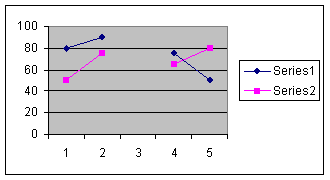
|
|
Functional |
Dysfunctional |
|
Stress (time) |
80 |
50 |
|
No Stress (no time) |
90 |
75 |
|
|
Functional
|
Dysfunctional |
|
Percent Rating (real) |
75 |
65 |
|
Confidence Rating (perceived) |
50 |
80 |
C1
C2
C1
C2
B1