 Learn 1
Monday, June 20, 2002
Classes begin August 26,
2002
Course
Syllabus
Psychology 222
Learning
and Memory
Psych 222
M-W-F
Section 01: 8:30-9:20
Room: D-19
Section
02: 9:30-10:20 Room: D-19
Fall, 2002
Instructor: Michael J. Lavin
Your name:
__________________________
Your address:
__________________________e mail@________
Web Page http://home.sbu.edu.
Your Phone#
__________________________
Course web page
http://web.sbu.edu/psychology/lavin/learnmemory,2002,fall.htm
and Lavin”s web page http://web.sbu.edu/psychology/lavin/
Text:
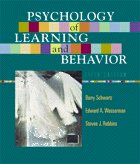
Schwartz, B., Wasserman, E.
A. & Robbins, S. J. (2002). Psychology
of Learning and Behavior. New York: John
Wiley.
Learn 2
Viewpoint: The
instructor's.
This course is
designed to be an intensive analytical
investigation of
basic and complex learning and memory
processes. It is not a theories course, although
theoretical
interpretations will
occasionally be discussed
I hope I am not being presumptuous in
assuming that you are
generally familiar
with basic learning principles and
paradigms—those
learned in Intro for example. Hope my particular biases will add a novel and
profitable addition to your burgeoning understanding of
learning (and
memory). Of course, the ultimate goal of this course is to determine how such
learning and memory principle have direct application to our everyday lives.
Since my dissertation days, I have assimilated some
rather radical
assumptions about learning, sort of neo-
evolutionary/
biological in nature (extremely in "nature").
It has always been my
position that learning is an evolved
biological process
(so is perception for that matter) which
permits the
processing capacity to infer relations, stimuli,
and events which
occur in time (space for perception). This
capacity, albeit,
constrained by its own biological-
physiological
limitations, has evolved laws and rules which
are shared by most
species. This is the Lavin credo and for
the remainder of the
course we shall be collectively
examining (and maybe
discovering) those core capacity laws of
learning.
I must admit also that over the years I have
mellowed a
bit and have expanded
my conception of learning to include
the organism as an
information-processor and opened the gates
of my learning
/memory model to include cognitive
interpretations.
We shall be using Schwartz, B (a compact little text) for much of the
semester and embellish our understanding of his chapters with research
articles, class
notes, and films. Schwartz’s text will provide the core but it is my responsibility to translate
that information to you via my comedy, anecdotes, overheads, and provided
germane internet sites.
In addition, the course will have its own
web page http://web.sbu.edu/psychology/lavin/learnmemory,2002,fall.htm
and I will be
downloading outlines for each lecture which you can use to prepare for class.
For example, there are 3 sections for this course so lecture 1 will be labeled
11@222 and the last lecture will be labeled 37@222.
Learn 3
Course objective: To formulate
a detailed understanding of the nature of learning and memory
processes as well as the ability
to see those processes operating in the
world beyond the classroom.
The following represents the
calendar part of the
syllabus which I shall try
to adhere while always recognizing
that a syllabus is a tool
designed to assist in course
organization but not
designed to stifle spontaneity and
curiosity.
___________________________________________________________
Section
I. Learning Without Awareness: Classical Conditioning. Schwartz et al (2002)
Chapters 1, 2, 3, 4, & pgs 110-113 & pgs 121-126.
Aug 26 Course introduction. Review course and
syllabus.
Discussion of mutual
expectations. Text(s), tests, research
articles, and the nature and importance of
classroom discussion and class attendance.
Silence is not
"golden." An introduction to
learning--A definition and
discussion
of the evolutionary importance of learning and
memory will be discussed. I will also photograph you via a
digital cameral to help me learn your
names and help you
learn the name of your colleagues. Those pictures
will be
downloaded onto our web page.
Aug 28 A introduction to learning. What learning
is an is not:
http://www.users.csbsju.edu/~tcreed/pb/misbehav.html#tal
A
definition
and the evolutionary importance of
learning. The importance of learning.
What is a response, and a stimulus.
S-R psychology.
Learning and adaptation.
Response
modification w/o
learning. Advantages and disadvantages
to
learning. Pg 13-18 Schwartz.
Learn 4
Aug 30 Sept 2 The primitive beginnings of behavioral
change: non- associative learning.
http://users.rcn.com/jkimball.ma.ultranet/BiologyPages/L/LearnedBehavior.html
http://www.uams.edu/department_of_psychiatry/slides/html/learning/sld054.htm
habituation and sensitization. Everyday
examples
plus Thomas Carew's work on the
physiological underpinnings of
sensitization and habituation. Chapter 2 Schwartz.
Sept 4,6, 9 Associative learning: Learning w/o
awareness.
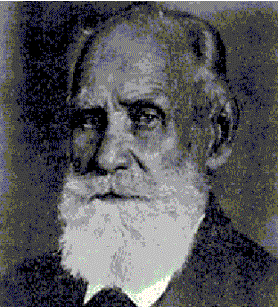
Pavlovian conditioning-
Basic and complex principles. Historical
introduction of I. P. Pavlov. Schwartz 3 –43-57
Learning
principles.
Acquisition, extinction,
parametric variables, Pavlovian inhibition
principles.
Everyday examples. 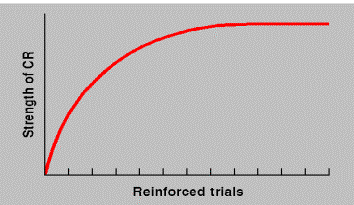 1)http://www.calpoly.edu/~qgardenh/
2)
http://www.mnsfld.edu/~mlaunius/Learn/sld001.htm
basics
http://www.mnsfld.edu/~mlaunius/Learn/sld002.htm
acquisition
3)
http://www.business.sc.edu/fall97/mktg758conditioning.htm
advertising
4) http://www.mnsfld.edu/~mlaunius/Learn/sld003.htm and example of conditioned flavor aversions: http://www.macalester.edu/~psych/whathap/diaries/diariesf95/Sarah/conditioning.html
Learn
5
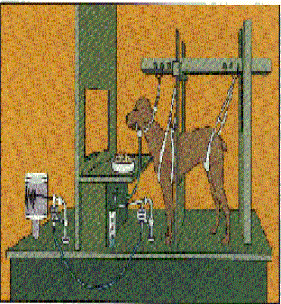
Stage 1 Stage 2 Stage 3
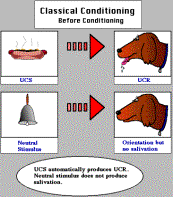
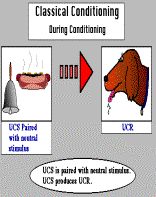
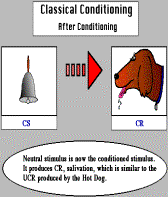
http://www.biols.http://www.biols.susx.ac.
http://www.users.csbsju.edu/~tcreed/pb/pavcon3.html
Sept 11, 13 Associative learning without
CS-UCS pairings.
Advanced Pavlov. Blocking p 101 Sensory Preconditioning pgs 110=113 sensory preconditioning - An association between stimuli established prior to the beginning of conditioning. For example, a light and a bell may be repeatedly paired 100 times; following this, the animal is conditioned to withdraw the foot in response to the light. After it has learned to make the conditioned response to the light, the bell is suddenly sounded. Experiments demonstrate that the bell will evoke the conditioned response, although the bell has never served as a conditioned stimulus before. Higher-order conditioning pg 113
|
Group |
First Order |
Second Order |
Extinction |
Test |
|
Experimental |
Tone ð Shock |
Light ð Tone |
Tone |
Light |
|
Control |
Tone ð Shock |
Light ð Tone |
- |
Light |
Learn 6
Sept 16, 18 Associative
Bias. Flavor-toxicosis learning. http://www.macalester.edu/~psych/whathap/diaries/diariesf95/Sarah/conditioning.html Internal, external, and disinhibition. . Lavin's
article on
sensory
preconditioning of
flavors.
This is a handout Seligman's
theory of cue utilization
and biological preparedness. A general review of
the general laws of learning (equipotentiality) vs
the neo-
evolutionary position. Culture, learning, and
eating. Schwartz 64-66 The premise of equipotentiality states that the
selection of the species, stimulus, response, reinforcer, and other aspects of
the experimental preparation is arbitrary. A considerable amount of evidence
now challenges this concept. As early as 1970, Seligman argued that the
dimension of preparedness must be included in the analysis of conditioning.
Preparedness refers to the idea that innate predispositions determine the
conditionability of any two events. Biological predispositions apparently do
determine what types of associations can be learned. Biological determinants of
behavior may intrude on the learning process.
Sept 20, 23.
Opponent-process theory of learning. Pavlov
reinterpreted.
Siegel's compensatory findings where the USR
does (Schwartz 122-126)
not equal the CR. Mucho examles. Will be reading a
drug
tolerance and learning article. Hinson and
Krank'sarticle on
The role of predrug signals in
morphene analgesic tolerance(1978). Pgs 61-62. When CR does not equal
UCR.
Sept 27 Contingency learning and Pavlovian
learning,
Robert Rescorla and the infamous .5 learning situation.
Lavin Notes. Schwartz 71-74
Sept 30 Applications of Pavlovian
conditioning. http://camden-
nt1.rutgers.edu/hart/intro/learning/tsld017.htm Lavin will discuss applications of Pavlovian
Conditioning and please read Schwartz 29, 53, 56, 77, 88
Learn 7
Oct 2 It is your turn. Application presentation day for those students who have chosen applications germane to section 1. http://www.science.mcmaster.ca/Psychology/psych2t3/topic6.html
Oct 4 Exam 1. Section I. Learning Without Awareness:
Classical Conditioning. Schwartz et al (2002) Chapters 1, 2, 3, 4, & pgs
110-113 & pgs 121-126 Multiple choice, short
identification, some matching, and 1
integrative essay question.
Readings: Lavin, Rescorla, and Hinson
and Krank. Emphasis on applications. Web sites
and
Schwartz pages. Study hard, historically
students have
struggled on this one.
Section
II. Operant response learning and
imitation learning. Schwartz 7, 8, 9 & 217-222

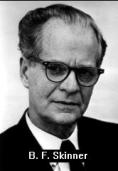 Pavlovian conditioning is largely responsible for our
motivation to respond in any situation. Operant conditioning, on the other
hand, is that we learn to do to satisfy those motivational states.
Pavlovian conditioning is largely responsible for our
motivation to respond in any situation. Operant conditioning, on the other
hand, is that we learn to do to satisfy those motivational states.
Learn 8
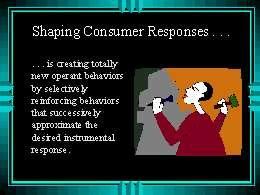
http://www.infoseek.com/Titles?qt=operant+conditioning&rf=11&sv=N6&st=10
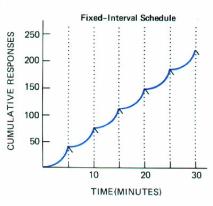
Oct 7
Principles and applications of
Instrumental/appetitive
conditioning. Comparison of Classical and Operant conditioning http://www.dushkin.com/connectext/psy/ch06/compare.mhtml
Schwartz 133-138
Oct 9 & 11 Shaping, schedules of reinforcement, chaining, . http://brembs.net/operant/operant.html
http://www.science.wayne.edu/~wpoff/cor/mem/operschd.html
superstition, http://www.gettysburg.edu/~arterber/psy101/learn3.html conditioned helplessness. 217-222
Oct 16 Nature of reinforcement. http://www.users.csbsju.edu/~tcreed/pb/operant.html
http://www.mcli.dist.maricopa.edu/proj/nru/opcond_ex.html
Extinction. Contingency management. Schwartz 178-180
Article: Reversibility of the reinforcement
relation by David Premack. http://brembs.net/operant/operant.html
Learn 9
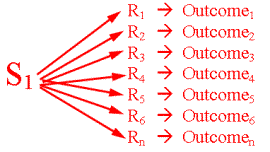
Oct 18 & 21 Principles of aversive conditioning.
Escape
conditioning. Avoidance.. Side effects of
punishment. Pgs 189-198
Punishment.Applications. Non-contingent
punishment. Side effects of rewards. Pg 160-162.
Oct 23 Article: Failure to escape traumatic
shock by M. E. P.
Seligman Handout. Conditioned helplessness. Conditioned helplessness .(infamous .5) M. Seligman http://www.noogenesis.com/malama/discouragement/helplessness.html
Spouse Abuse: http://ucl.broward.cc.fl.us/pathfinders/spouse.htm Schwartz 173-175.
Oct
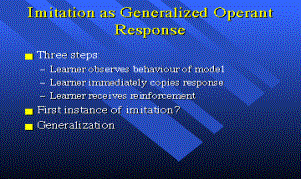
23 Learning by observation. Imitation as an
instinct. Factors that affect the likelihood
of imitation. What can be learned through
observation? Maybe phobias and addictions.
Oct 25 What about aggression? The
relationship
between aggressive behavior and watching
aggressive television. Lavin notes.
Article:
Imitation of film-mediated aggression
by Bandura, A., Ross, D. & Ross, S. A.
Learn 10
Oct 28 Lavin discusses operant applications:
clinical, behavioral,
Etc Skinnerian Applications See Schwartz 144,147,158,159,175,195, 212
· The Learning Styles of Horses
· Animal Training at Sea World. A good introduction to aPractice examples of reinf orcement and punishment. Try your hand at identifying examples of the effec ts of two consequences of behavior, reinforcement and punishment.
· The Behav ioral Approach. A good overview of the behavioral position with description s of Pavlov, Watson, and Skinner as well as a brief overview of Types of Learnin g and assessment techniques.
· A position paper on Aversive Co nditioning.
· Operant Conditioning and Behaviorism - a historical outline.
· Operant (Instrumental) Conditioning. Another good overview of operant con ditioning with general principles.
· Features of Classical Conditioning
· Factors Determining the Effectiveness of Classical Conditioning.
· F eatures of Operant Conditioning.
· Operant Conditio ning I Descriptions and examples of positive reinforcement, negative reinfo rcement, positive punishment, and negative punishment.
· More examples of reinforcement and punishment.
· nimal behavior an d animal training.
http://mmg2.im.med.umich.edu/~kleung/training.html
Mammal training
http://www.pacificnet.net/~jmcnary/training.html
Test questions for Operant http://www.multimedia.calpoly.edu/libarts/cslem/wt/7Obj.htm
Oct 30 Applicaion presentation day for those students chosing
operant or observational applications.
Nov 1 Section II. Operant response learning and imitation learning. Schwartz 7, 8, 9
& 217-222
Test 2. Schwartz chapters and pages, , articles,
class notes, web sites by
Premack, Seligman, , and Bandura.
Learn
11
Section
III Cognitive learning, language and
memory Schwartz 13. 14, 15
Nov 4 Cognitive control of behavior and
cognitive
Nov 6 learning processes. Concept
learning. Animal cognition and
human cognition. Schwartz 310-315
Tolman's type of behaviorism. Problem
Nov 8 &11 Language. Concept formation and
reasoning. Lavin notes.
Article: Savage-Rambaugh and two-way
communication
with an infant chimp. How language facilitates
learning and
memory.


 http://www.valdosta.edu/~whuitt/psy702/cogsys/infoproc.html
Learn 12
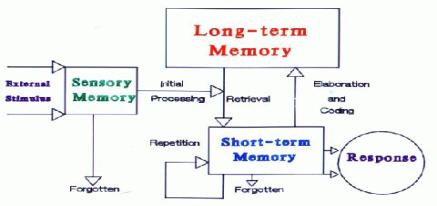
Nov 13 Storage of experience. Three-stage
view.
Nov 15 STM, consolidation, LTM and
retrieval.
Iconic, Echoic memory. Schwartz Ch 14
Experience encoding. Organization of
Nov 18 experiences (e.g., chunking, coding,
Nov 20 rehearsal function of STM.
Application De
Nov 22 Mnemonics. Film on memory. Discussion
of levels of
processing, organization. Schwartz 15
Article: Control of short term memory by
R. C. Atkinson and R. M. Shiffrin.
· False Memory Syndrome Foundation Home Page
· Open Letters Regarding 'False Memory Syndrome'
· Recovered Memories or Modern Witch Hunt?
· Memory Improvement Techniquesfrom Mind Tools
· PsychWeb has a mirrow site for Mind Tools where you can find information about memory improvement, mindmapping, brainstorming, problem solving and a number of other self improvement topics.
· Brain Memory Learning and Mind Mapping Site - Tony Buzan
· Buzan Centre of Tronto Home Page
· Mind Maps and Ma king Mind Maps
· NOTESof W.H. Calvin on human memory mechanisms.
· Behavior Analysis Home Page, University of South Florida
Learn 13
Dec 2 Memory retrieval and forgetting.
Bringing up
Dec 4 the past. Attributes. Memory loss or
amnesia. LTM
Decay of memory. Anatomical basis of memory
retrieval. Interference. Film on memory loss.
· Total Recall is a co mmerical site, they sell something, in this case Memory Training. Although it i s a commerical site, useful information is provided about memory and memory impr ovement. Take a look.
· There are several good OUTLINES concerning topics in the study of memory:
o Imagery
Dec 6 Lavin gives lecture on application of our
knowledge of language and memory. Schwartz 366, 368, 375 377
Dec 9 Applicaiton presentation day for those chosing applications
relevant to this section on cognitoin, language,
and memory.
Dec___& time
______01_____& time 02 Final
Section
III Cognitive learning, language and memory
Schwartz 13. 14, 15 &
Lavin notes with emphasis
on
applications. Test date will be designated by
officially given times. I don’t know them now but will by December. Hard to
think about December when it is sunny and 78 out here.
Your final
grade will be based on the following percentages:
Test I: 30
%
Test 2 30%
Final 30%
Class
presentation/application either for classical, operant, or memory.
10% (5% class presentation, 5%
paper)
Learn 14
Major course focus: Being
able to understand basic learning
principles, parameters, and
paradigms and be able to apply
those findings to real life
settings. In addition, you should
be able to see how these
experiences are organized into
memory by retrieval and
encoding processes. Is that what you learned?

Good Luck. MJL 06/16/02
Office Hours: M-Thur
1:00-3:30
eMail address Mlavin@sbu.edu
·
Take note: This syllabus is not you average syllabus.
It contains valuable pedagogical and learning information. Tables, figures,
urls ( e. g., Remembering
Dangerously are provided to assist you in your assimilation process. Good
luck! mjl
6/18/2002